
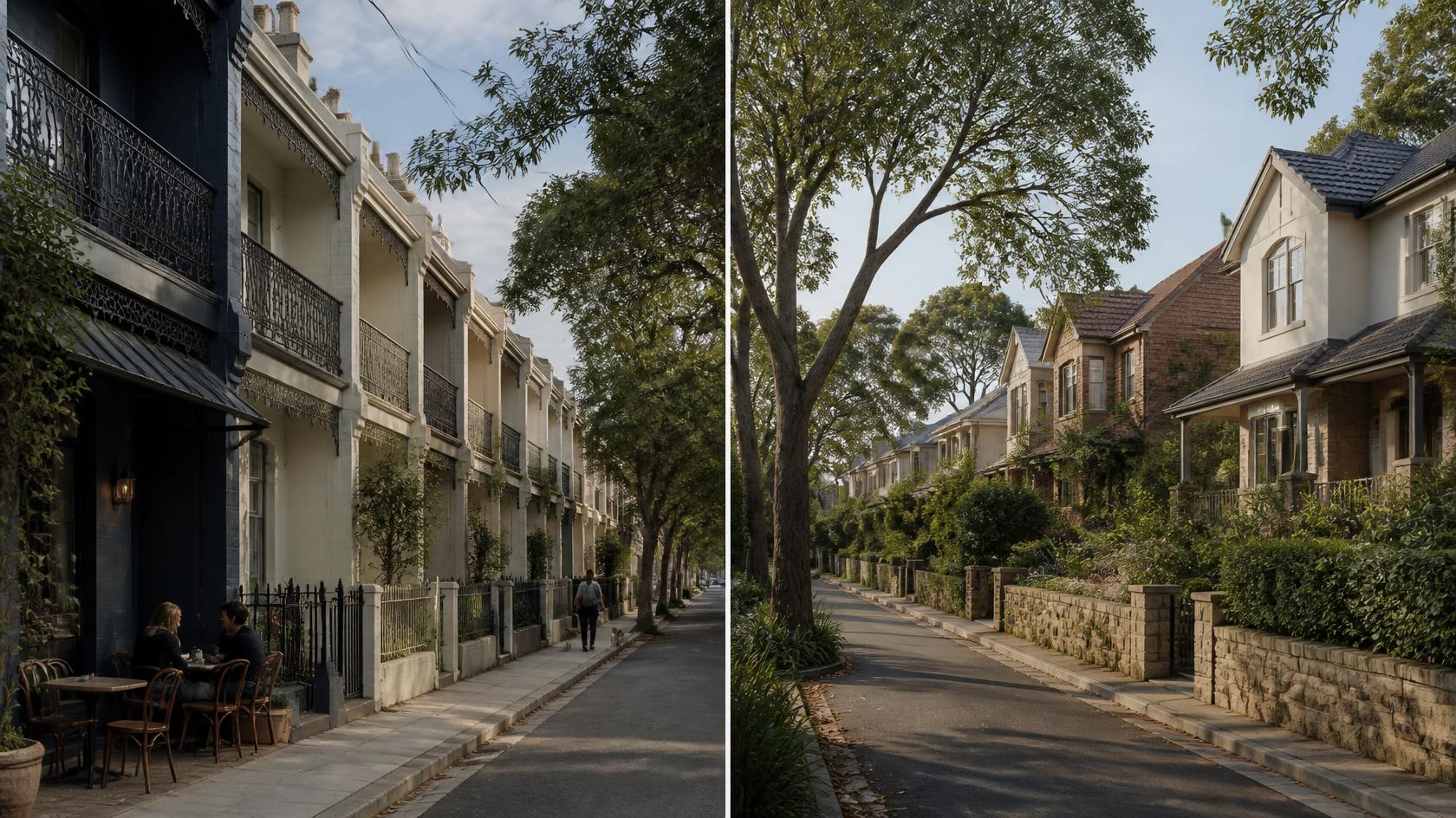
The Inner West and the North Shore represent two genuinely different versions of established Sydney living, and buyers researching both regions for the first time are often surprised by how different the underlying dynamics are — not just in price, but in housing stock, buyer competition, and lifestyle trade-offs.
Price Point and Housing Stock
Broadly speaking, the North Shore — spanning suburbs from the Lower North Shore through to the Upper North Shore — carries a higher median price point across most property types, reflecting larger blocks, established leafy streetscapes, and highly regarded school catchments. The Inner West offers a genuinely wider spread, from higher-priced pockets close to the CBD and harbour through to more accessible terrace and semi-detached stock further out, making it a common entry point for buyers priced out of the eastern and northern established suburbs.
Housing Typology Differences
The Inner West is characterised heavily by terrace houses, semi-detached homes, and a growing apartment stock along transport corridors, reflecting its older, denser urban form. The North Shore skews toward larger detached houses on bigger blocks, particularly in the Upper North Shore, alongside a growing apartment and townhouse market closer to train stations and shopping precincts. This typology difference matters practically — if you specifically want a larger block with room to extend, the North Shore generally offers more options; if you want walkable village-style living with cafes and transport at your door, the Inner West’s density works in your favour.
Commute and Transport
Both regions are well served by rail, but the routes and travel times differ: North Shore suburbs generally connect via the North Shore line into the CBD, while Inner West suburbs are served by a mix of rail, light rail, and bus corridors with generally shorter travel times into the CBD given their closer proximity.
School Catchments
Both regions include some of Sydney’s most sought-after public school catchments, and in both cases catchment boundaries can materially affect price for otherwise comparable properties. If schooling is a priority, checking current catchment maps directly with the NSW Department of Education for the specific property — not just the suburb name — is essential, since catchments don’t always align neatly with suburb boundaries.
Which Suits Your Search?
Buyers prioritising walkability, cafe culture, and a shorter commute to the CBD often gravitate to the Inner West; buyers prioritising larger blocks, established greenery, and specific school catchments often lean North Shore. Budget will do much of the deciding for most buyers, but it’s worth physically spending time in both regions — on a weekday and a weekend — before committing to a search strategy based on reputation alone.
Once you’ve settled a target suburb, engaging a buyers agent with specific experience in that pocket — rather than a generalist covering all of Sydney — tends to sharpen your search considerably; see our guide on choosing a buyers agent for the specific questions to ask.
Frequently Asked Questions
Which region generally offers better rental yields for investors?
This varies considerably by specific suburb and property type within each region, and shifts over time — current yield data from a buyers agent or data provider active in both regions is more reliable than a general rule of thumb.
Are strata fees typically higher in the Inner West or North Shore?
It depends heavily on the specific building’s age, amenities, and any planned capital works, more than the broader region — always review the strata report for the specific property rather than assuming based on location.
Can I get a similar lifestyle to the Inner West for less in nearby suburbs?
Often yes — suburbs adjacent to the well-known Inner West postcodes can offer a similar walkable, cafe-driven lifestyle at a more accessible price point, and are worth including in your search if pure brand recognition isn’t a priority.
Further Resources
To check specific school catchment boundaries for a property you’re considering, use the NSW Department of Education school finder. For suburb-level profile data on both regions, Domain publishes regularly updated suburb statistics.
Watch: Inner West vs North Shore Compared
Search YouTube for “Inner West vs North Shore Sydney suburb comparison” and choose a video from a local buyers agent or suburb-review channel. Replace the placeholder below once you’ve selected one.
Key Takeaway
Both regions offer genuinely strong, established Sydney living, but the trade-offs — block size versus density, commute routes, and price point — are different enough that spending real time in each before committing to a search strategy pays off.
It is also worth factoring in how each region has responded to past infrastructure changes, such as new light rail or metro connections, since areas that have already absorbed a wave of transport-driven demand may behave differently going forward compared with areas where similar upgrades are still being delivered.